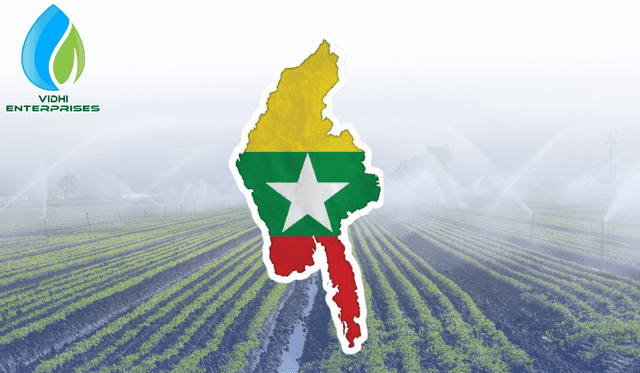
Drip Irrigation & Sprinkler Systems for Myanmar
Introduction
Myanmar is a country in Southeast Asia with a strong agricultural tradition. Farming plays an important role in its economy and provides employment and income for many rural families. The country grows a wide range of crops, including rice, pulses, beans, maize, vegetables, fruits, and oilseeds. Agriculture depends heavily on seasonal rainfall, but changing weather conditions and dry periods can make water management difficult for farmers.
Modern irrigation systems can help farmers manage water more carefully and provide crops with a more regular supply when rainfall is insufficient. Drip irrigation, agricultural sprinklers, and suitable irrigation accessories can support different farming needs across the country. Vidhi Enterprises offers irrigation products designed to help agricultural users and distributors find practical solutions for their watering requirements.
Market Insights
Myanmar has varied agricultural conditions, from the fertile areas of the Ayeyarwady Delta to the central dry zone and other regions with different rainfall patterns. Rice is one of the country's major crops, while pulses, beans, sesame, groundnuts, vegetables, and fruits also contribute to agricultural production.
Irrigation requirements differ from one region to another. Farmers in areas with seasonal water shortages may need dependable systems to support crops during dry periods. Vegetable growers and fruit producers may benefit from drip irrigation, which delivers water close to plant roots. Sprinklers can be useful for suitable open fields, nurseries, and other areas where overhead watering is appropriate.
The choice of equipment depends on crop type, soil conditions, field size, water availability, and the pressure available from the water source. Farmers also need equipment that is straightforward to install, operate, and maintain. Affordable products and access to replacement components can be especially important for small and medium-sized farms.
Products We Supply
Vidhi Enterprises supplies irrigation products for agricultural applications. The following table outlines key product categories and their typical uses in Myanmar.
| Products | Key specifications | Typical uses |
|---|---|---|
| PC and Non-PC Drip Systems | Different dropline options for varying field and water- pressure requirements | Vegetable cultivation,row crops, and other suitable plantations |
| Inline Drip Pipes | Drip pipes with emitters integrated into the line | Regular watering for crops planted in rows |
| Flat Dripline | Flexible flat dripline options, selected according to field requirements | Seasonal crops and planned row irrigation |
| Drippers and Emitters | Different emitter options for controlled water delivery | Supplying water close to individual plants |
| Agricultural Sprinklers | Sprinklers options selected according to coverage, pressure and flow requirements | Suitable field crops, nurseries, and open growing areas |
| Drip Fittings and Connectors | Compatible connectors,joiners,tees, elbows, and related components | Connecting drip lines and maintaining irrigation layouts |
| Irrigation accessories | Supporting components selected for the intended system | Installation, routine maintenance, and system operation |
The products selected for an irrigation project should be compatible with one another. Before ordering, buyers should confirm pipe dimensions, emitter spacing, flow rate, operating pressure, connection sizes, and water quality requirements. These checks help ensure that the system is suitable for the farm and easier to maintain.
Industries We Serve
Agriculture and Field Farming: Farmers growing rice, pulses, beans, maize, oilseeds, and other crops may require irrigation equipment suited to their field layout and water supply. Drip systems and sprinklers can be considered where they match the crop and growing conditions.
Vegetable Farming: Vegetable growers often need controlled and regular watering. Drip irrigation can supply water near plant roots and help reduce unnecessary watering between crop rows.
Fruit Farms and Plantations: Fruit crops and selected plantation applications may benefit from targeted irrigation. The system should be designed around plant spacing, soil conditions, and the amount of water available.
Nurseries and Plant Growers: Nurseries need suitable watering arrangements to support young plants. Drip equipment and appropriate sprinklers can be considered according to plant size and growing arrangements.
Irrigation Dealers and Distributors: Agricultural equipment dealers can source products for farmers, contractors, and local customers. A suitable product range can help meet different irrigation requirements.
Why Import Irrigation Equipment from India?
India has an established agricultural equipment and irrigation manufacturing sector. Importing from Indian suppliers can provide buyers with access to different product options for farms, irrigation projects, and distribution businesses.
For Myanmar buyers, working with an Indian supplier may offer the opportunity to source drip irrigation products, sprinklers, fittings, and related components through one supplier, depending on product availability and order requirements. Buyers can also request product specifications before placing an order, making it easier to check compatibility with their planned installation.
Importers should consider product quality, pricing, shipping costs, delivery schedules, import documentation, and local requirements before making a purchasing decision. Comparing the complete order cost, rather than only the unit price, can help businesses plan more effectively.
Benefits of Efficient Irrigation
- Better water management: Suitable irrigation equipment helps deliver water according to crop requirements.
- Controlled watering: Drip systems can supply water near plant roots instead of wetting the entire field surface.
- Flexible applications: Different irrigation products can be selected for different crops and field layouts.
- Practical farm management: A well-planned system can make watering schedules easier to organise.
- Support for crop production: Reliable irrigation can help crops receive water during periods when rainfall is insufficient, provided that water is available and the system is correctly operated.
Results depend on the equipment selected, installation quality, maintenance, crop requirements, and local growing conditions.
Why Vidhi Enterprises?
Vidhi Enterprises understands that irrigation requirements vary between farms and agricultural projects. Selecting suitable products involves more than choosing an item from a catalogue; it also requires attention to the intended application, product specifications, and compatibility with the existing system.
We aim to help buyers identify suitable irrigation products for their requirements. Whether a customer is looking for dripline options, drippers, sprinklers, or compatible fittings, the product selection should be based on the needs of the project.
Our focus is on providing clear product information and helping customers make informed purchasing decisions. Buyers can share their crop type, approximate area, water source, and required quantities so that the relevant product options can be discussed.
Frequently Asked Questions
The right system depends on the crop, soil, field size, water source, and local climate. Drip irrigation may suit vegetables and row crops, while sprinklers can be useful for suitable open areas.
Drip irrigation delivers water close to plant roots, which can reduce unnecessary wetting of the soil surface. Actual water savings depend on system design, maintenance, and irrigation practices.
No. Sprinklers are useful for certain crops and field conditions, but they may not be the best option for every crop or location. Pressure, wind, soil infiltration, and crop sensitivity should be considered.
Buyers should confirm dimensions, flow rates, operating pressure, emitter spacing, connection compatibility, water quality, quantities, and delivery requirements.
Yes. Systems can be planned for small farms as well as larger agricultural operations. The layout and equipment should match the available budget, water supply, and area to be irrigated.
Yes. Buyers can contact Vidhi Enterprises with their required products, quantities, specifications, and delivery location to discuss availability and order arrangements.